Build Your Wishlist

The first step to securing funding is building a plan for your program. Let us help you get started.

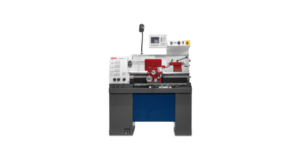
CNC Turning Machine Maintenance Training Platform

A real CNC lathe plus a fault-setting electrical cabinet — programming, electrical design, debugging, and lathe maintenance training on one lab platform.

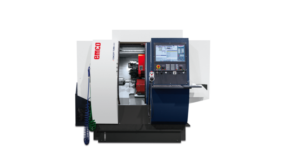
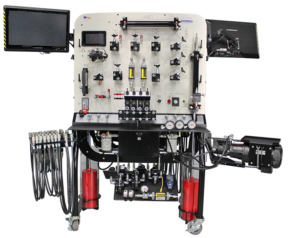
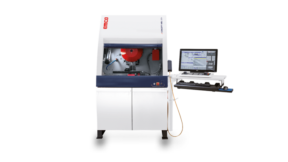
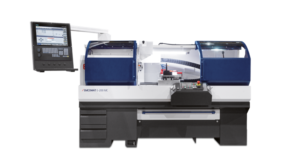
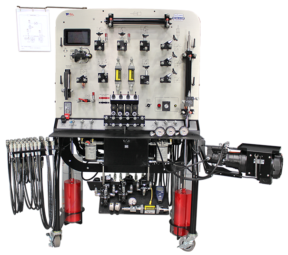
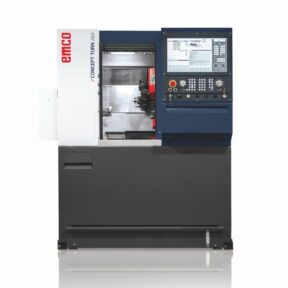
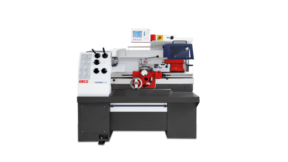
The CNC Turning Maintenance Experimental Platform combines a fault-setting electrical cabinet with a fully operational CNC lathe. Students program and machine parts on live hardware while also practicing CNC lathe maintenance and repair. It is intended for undergraduate and vocational colleges teaching CNC technology.

The modular cell covers CNC programming, electrical design, installation, debugging, and machine operation in one high-tech training system.

Product Details

Why Labs Use This Platform

  • Integrated learning experience — Fault-setting electrical cabinet plus a real CNC lathe for hands-on training.
  • Versatile training capabilities — Practical CNC programming, maintenance, and repair.
  • Modular design — Flexible expansion and combination, with easier inspection and debugging.

This is a standard CNC machine tool, not a desktop mock-up. Students can disassemble, adjust, and operate authentic hardware: two-phase hybrid stepping motor, high-speed constant-torque spindle, ball screw, origin/limit switch, electronic handwheel, and cooling water pump.

What Students Work On

Key building blocks include the CNC system, spindle speed-control units, XZ motion-axis units, and switch input/output units. The lathe supports two-axis work from cylindrical and curved-neck turning through ball-head and thread cutting. Catalogue materials include steel, iron, copper, aluminum, plexiglass, plastic, and wax molds. The machine is described as compact, high-speed, and straightforward to operate.

List of Experiments

  1. Principle and composition of CNC system
  2. Composition, adjustment, and use of the motor drive system
  3. Connection and debugging of CNC system
  4. Parameter setting and adjustment of CNC system
  5. Composition, debugging, and use of spindle speed-control system
  6. CNC programming and machining operation
  7. Electrical design, installation, wiring, and debugging of suspended handwheel
  8. Programming and debugging of PLC
  9. Fault setting and troubleshooting of CNC lathe
  10. Machine tool return-to-reference-point experiment
  11. Tool-rest control principle experiment
  12. Screw-rod return error compensation experiment
  13. Installation and fault-diagnosis experiment of spindle encoder
  14. CNC lathe processing training

Technical Details

Item Specification
Platform construction Metal-plate integrated cabinet; electrical installation platform and controller plane in an L-shaped layout
Electrical installation platform 220 × 100 cm
Mobility 4 swivel casters with brakes
Electrical cabinet test bench (L × W × H) 80 × 90 × 190 cm
Axes 2-axis CNC turning with ball screws
Cooling Yes — G-code controlled water pump
Handwheel Hanging electronic handwheel (MPG)
Ball screw Precision double-nut ball screw, heat treated and precision ground
CNC system Siemens 808D Advance
Positioning accuracy 0.03 mm
Repeatability 0.02 mm
Maximum turning diameter 210 mm
Maximum clamping diameter 80 mm
X / Z travel 80 mm / 290 mm
Spindle speed Stepless 300–1,750 rpm ±10%
Maximum moving speed 4,000 mm/min
Maximum feed speed, Z 2,000 mm/min
Maximum feed speed, X 2,000 mm/min
Electric turret 4-position
Spindle through-hole 20 mm
Thread turning Yes
Spindle taper Morse No. 4 (catalogue: “Mohs No. 4”)
Tailstock taper Morse No. 2 (catalogue: “Mohs No. 2”)
Motor-driver resolution 0.0025 m (as printed; confirm unit with EMT — likely 0.0025 mm)
Spindle output power 1,100 W
Power requirement 3-phase 380 V


Transportation Catalog
DAKTIC-Transportation-2025-FINAL-compressed.pdf