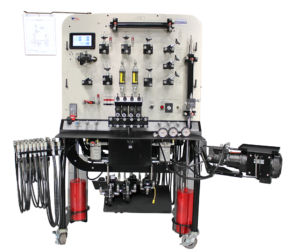
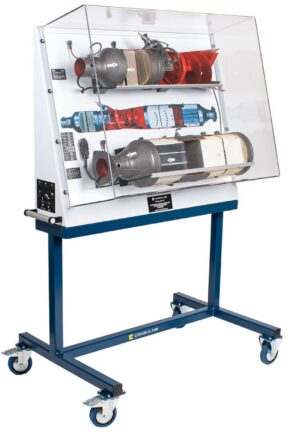
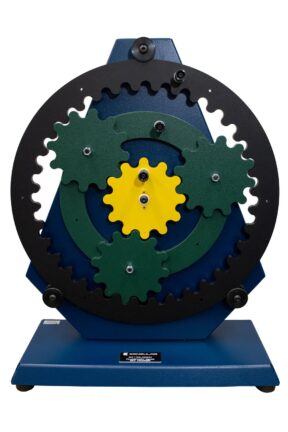
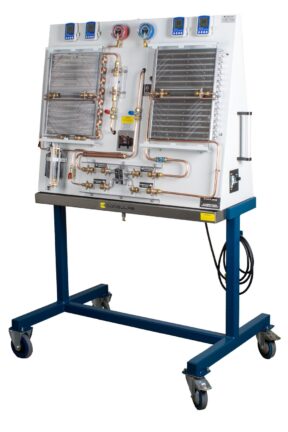
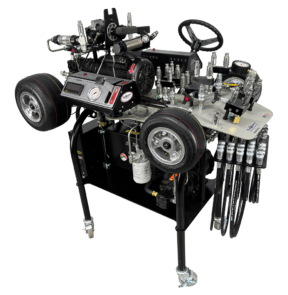
The MF600-1HP (1-HumanPower™) Basic Hydraulics Training System is a zero-emissions, human-powered learning platform that teaches fundamental hydraulics in the most intuitive way possible. By using the student as the prime mover, the system allows learners to feel how changes in flow, pressure, torque, and horsepower directly affect actuator behavior. Pedaling speed becomes flow. Pedaling force becomes pressure. These real-time cause-and-effect relationships make abstract concepts instantly understandable.
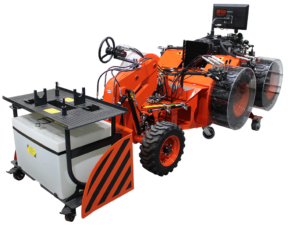
A back-lit crane assembly with boom, mast rotation, and hydraulic winch enables learners to see pressure, area, load, torque, and speed interactions in a clear and visual format. With digital instrumentation and a complete set of industrial hydraulic components, the MF600-1HP provides one of the most engaging and memorable introductions to hydraulic science, perfect for high schools, technical colleges, workforce development, and entry-level industry training programs.
Product Details
Key Features + Benefits
Students Experience Hydraulics Physically — Not Theoretically
Because the student is the prime mover, they immediately feel how changes in pedal force and speed affect system pressure, flow, and actuator response.
Makes Pressure, Force, Torque and Area Concepts Easy to Understand
The crane boom cylinder shows how pressure changes with surface area when the load is held constant. These concepts are normally difficult to teach with theory alone.
Real Hydraulic Components for Real Learning
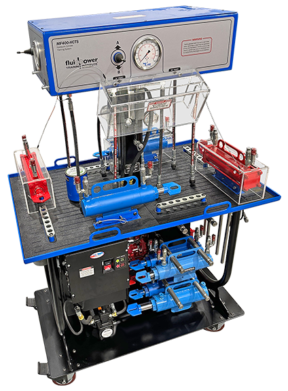
The system includes cylinders, motors, a fixed-displacement pump, D03 solenoid valves, flow controls, a hydraulic winch, and digital instrumentation, all visible and accessible.
Zero Emissions. Zero Noise. Zero Hazards.
The only power source is the student, making the system ideal for indoor classrooms, labs, and youth training environments, no electrical motors, no fumes, no risk.
Brings Hydraulics to Life Through Movement
Learners see actuator speed change as they pedal faster or slower and see pressure rise as the load increases or boom geometry changes.
Supports 14 Essential Learning Outcomes
Includes hydraulics safety, torque calculation, actuator speed calculation, pressure differential, hydraulic horsepower, force/area relationship, pump behavior, and more.
Specifications
Prime Mover + Power System
Prime mover: student-powered (pedal-driven)
Human mechanical energy converted to hydraulic energy via flywheel and belt-driven pump
Pedal speed = flow rate
Pedal torque/force = pressure generation
Crane Functions
Boom raise/lower (dual-acting cylinder)
Mast rotation left/right (180° either direction)
Hydraulic winch with belt and hook for attaching weight
Hydraulic Components
Fixed displacement gear pump
Dual double-acting cylinders (boom raise/lower)
Single-rod double-acting mast extension cylinder
(2) Bi-directional hydraulic motors (belt reel and rotation)
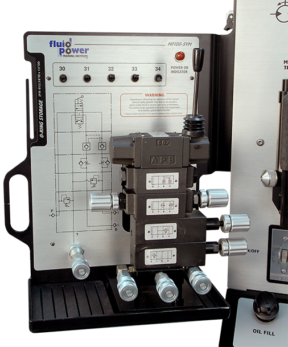
(4) D03 solenoid-controlled directional valves
One-way flow control valve
0.75-gallon (3.79 L) hydraulic tank
Digital Instrumentation
Flow meter
Pressure gauge
Digital tachometer (pedal/flywheel speed)
Seat + Ergonomics
Comfortable gel seat
Tool-free height and lateral adjustment
Learning Activities (14 Outcomes)
Students learn:
Hydraulic safety
Force and torque calculation
Relationship between flow, speed, and torque
Actuator speed calculation
Pressure sourcing and pump behavior
Load vs. pressure changes
Pressure vs. area relationships
Hydraulic horsepower
Pressure differential
Dimensions + Shipping
Height: 80″ (2032 mm)
Width: 51.5″ (1308 mm)
Depth: 89″ (2261 mm) at full boom extension
Shipping weight: 700 lb (318 kg)
Curriculum Overview + Topics Covered
Overview The MF600-1HP curriculum allows students to physically experience how hydraulic variables interact by using their own power to generate flow and pressure. Hands-on crane operations reinforce fundamental hydraulic concepts.