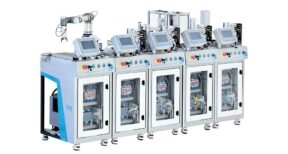
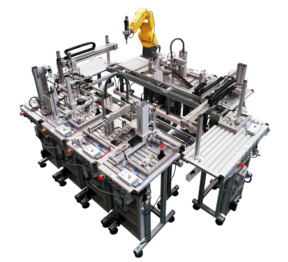
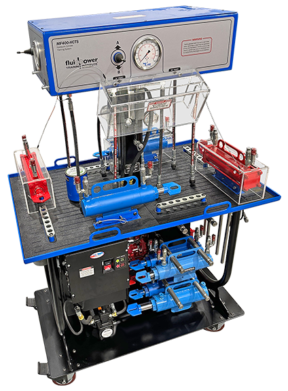
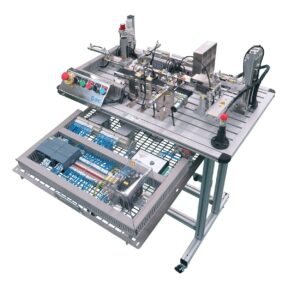
The MAP-200s consist of a series of individual tabletop mechatronics training systems that carry out a specific and different material handling task commonly seen in industrial settings.
Robust, Rugged, and Versatile, these tabletop hands-on training systems are designed to teach students a wide array of industrial automation – Pneumatics, Electrical, Industrial Safety and Automation Processes, PLC Programming, Sensors, and Troubleshooting!
Product Details
Body Supply Part Feeder + Detector/Ejector (MAP-201)
The MAP-200s consist of a series of individual tabletop mechatronics training systems that carry out a specific and different material handling task commonly seen in industrial settings.
Vacuum-Held Handling Device with Two Shafts (MAP-202)
MAP-202: The function of this handling device is to transfer the part from a starting area to a final unloading area, using three vacuum pads. This is a cartesian handling device with two shafts which moves a part from one position to another, holding it with a set of three vacuum pads.
Vertical Revolving Handling Device with Internal Gripper of Bearing (MAP-203)
The function of this material handling device is to transfer the part from a starting area to an unloading area, using an internal gripper. The part used in this process is a bearing so that when it is placed on the unloading area, it fits perfectly onto a stainless steel pivot with a slightly smaller diameter than the bearing’s inner diameter.
Horizontal Rotolinear Handling Device with External Gripper of Shaft (MAP-204)
The function of the handling device is to transfer the part from a starting area to an unloading area through a rotolinear actuator that displaces an outer gripper. The part being transported is a metal bearing.
The part used is made from anodized aluminum, 14.6mm diameter and 41mm height, so that when the part is placed on the unloading area it fits perfectly onto a stainless steel pivot with a slightly larger diameter than the shaft.
Complete Mini-Cell Assembly (MAP-205)
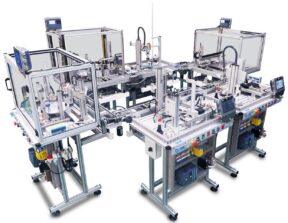
The MAP-205 combines the MAP-201, MAP-202, MAP-203, and MAP-204 into a single integrated mini-cell assembly.
The MAP-205 assembles and disassembles a product (metal turning mechanism) via 4 handling devices working together on a single tabletop frame.